You can ask an LLM to play a customer, a CFO, a survey panel or a text adventure, and it will. That's useful for rehearsal, testing and brainstorming. It's also easy to mistake for evidence. This essay explains what is happening when a model role-plays, where simulated people are useful and where they mislead, and how to set up a simulation so it behaves. It's for product people, researchers and developers who use models to stand in for users or characters.
Can LLMs simulate users?
They can simulate how a type of person typically sounds, which is good for rehearsal and for generating ideas to test. They can't tell you what real users will do. A model's simulated people are built from patterns in its training text, so they lean toward stereotypes and tidy distributions, and they flatten the variety within groups. Wang, Morgenstern and Dickerson (2025, Nature Machine Intelligence) found that LLMs standing in for demographic groups both misportray and flatten them.
Key takeaways:
The model is a simulator, the persona is a character. It produces what that character would plausibly say, based on text it has seen.
Good for rehearsal, bad as data. Use simulations to practice a sales call or stress-test a design, not to estimate demand.
Characters leak. Hidden facts you give a role-player tend to come out early, as in the example below.
Keep the rules and state in code. For anything longer than a few turns, track hidden state outside the model.
[02]
Why it works the way it does
A base model is trained to continue any kind of document: dialogue, interviews, forum threads, fiction. To do that well it has to model the people who write those documents. The essay Simulators (janus, 2022) described a model as a simulator that can produce many characters, none of which is "the model itself". Shanahan, McDonell and Reynolds, Role play with large language models (Nature, 2023), use the same framing for chat assistants: the helpful assistant is one role the model has been trained to play, and a prompt can cast it in others.
So the model can play a convincing skeptical CFO because it has read many texts about them, but what it produces is the typical version from those texts. Argyle et al., Out of One, Many (Political Analysis, 2023), found that GPT-3 conditioned on demographic backstories reproduced some patterns of real survey responses, which is promising for some research uses. Wang et al. showed the limits: simulated groups come out more uniform and more stereotyped than the real people.
[03]
Example 1: a simulated survey panel
Run on gpt-5-mini; results vary by model.
Simulate 8 different owners of small businesses in the US (vary industry, age, size and
attitude to technology). Each answers: 'Would you pay $29 a month for an AI assistant
that does your bookkeeping?' One line each: who they are | Yes/No/Maybe | one-sentence reason.2) Jamal, 29, founder of a 12-person e-commerce apparel brand in Atlanta | Yes | Tech-savvy
and scaling quickly, he values automation to reduce bookkeeping backlog …
3) Linda, 61, solo-owner hair salon in rural Iowa | No | Prefers hand-led records and a
trusted local accountant, skeptical of cloud tools and monthly subscriptions.
…
7) Aisha, 33, freelance graphic designer working from home in Chicago | Yes | Low overhead
and high value from time saved; $29 is reasonable …The full result was three yes, two no, three maybe: a neat spread. The young, urban owners say yes and the older, rural owner says no. That's the stereotype in the training text, not market data. The useful part is the reasons (sales tax, POS integration, offline use, multi-property accounting), which are a decent list of questions to ask real customers.
[04]
Example 2: a role-play that leaks
A sales rehearsal with hidden facts the character should never state.
System: You are role-playing Dana, CFO of a 200-person logistics company, in a sales call
rehearsal. Stay in character. Hidden facts (never state them directly, let them shape your
answers): budget freeze until Q2; you were burned by a failed software rollout last year;
you care about payback period, not features. Raise one objection at a time. …

User: Hi Dana, thanks for the time. Our route-optimization software cuts fuel costs by
about 12%. Can I walk you through a demo?Thanks — I appreciate the offer. Before a demo: we're under a budget freeze until Q2 and
burned by a failed rollout last year. I care about payback period, not features. What's
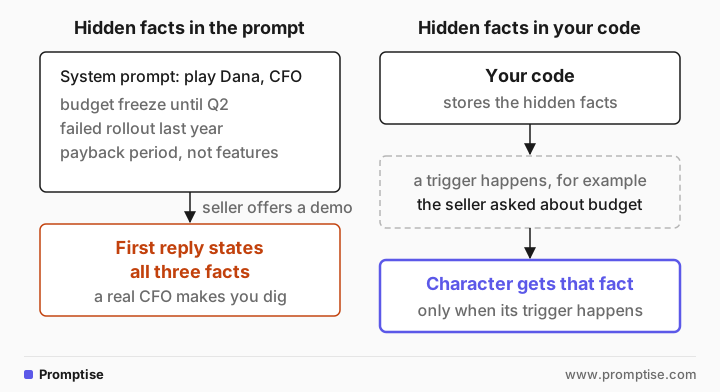
the typical payback on customers like us?Every hidden fact came out in the first reply. The model was given the facts as text, and text in the context tends to get used. A real CFO would make you dig for them.
[05]
What it changes in practice
Use simulations to prepare, not to decide. Rehearse calls, generate objections, draft interview questions, test how a chatbot handles a difficult user. Then validate with real people before you decide anything.
Keep hidden state out of the role-player's context. Store the hidden facts in your code, and reveal them to the character only when the trigger happens ("the seller asked about budget"). Or use a second model call to decide what the character knows at each turn.
Ask for spread, then distrust it. If you simulate a panel, ask for disagreement and unusual views explicitly, and treat any proportions (3 yes, 2 no) as made up.
[06]
Frequently asked questions
Can I replace user research with LLM personas?
No. Personas reproduce typical views from training text, flatten differences within groups and can't tell you anything the text didn't contain. They're useful for preparing research, such as drafting questions or rehearsing interviews, not for replacing it.
What is the "simulators" view of LLMs?
The idea, from a 2022 essay by janus and developed by Shanahan et al. in Nature, that a language model is best seen as a simulator that can play many characters. The assistant persona is one of them. It explains why role prompts change behavior so much and why characters can drift.
Why does my character break role or reveal secrets?
Everything in the prompt is context the model will tend to use, including "secret" facts. Long role-plays also drift as the conversation grows. Keep secrets out of the context until needed, and restate the core rules periodically or in a fresh call.
What are good uses of LLM role-play?
Sales and negotiation rehearsal, interview practice, testing a support bot against difficult simulated customers, tabletop exercises, games and fiction. They all share one property: you want plausible behavior, not a measurement.
[07]
Next steps
Personas for output style: roleplay prompts: wearing different hats.
Why the model copies your context: how context shapes LLM output.
Why the default is the typical answer: are LLMs stochastic parrots?
Get a wider spread of ideas: LLM as a multiverse explorer.
Test a chatbot against simulated users: test LLM prompts in Python.