Contents · 11 sections↓
- 01What are decision models, and why should leaders care?
- 02How do decision models work?
- 03Who offers decision models today?
- 04Where decision models cut cost and delay
- 05When to use decision models (and when not)
- 06How to run a safe decision-model pilot
- 07Pilot readiness checklist
- 08Questions to ask your team
- 09Common mistakes
- 10FAQ
- 11Next steps
Decision models are a new kind of AI model built for one job: making the same small, routine decision thousands of times a day, fast and cheaply. Instead of writing text, they pick an answer from a list your team defines and say how sure they are. This guide explains in plain words what decision models are, where they cut cost and waiting time, where they fail, and how to run a small, safe pilot.
What are decision models, and why should leaders care?
A decision model is an AI model that answers a fixed question, such as "which team should handle this?" or "does this message promise a refund?", by choosing from options you set in advance and giving a probability for each one. It doesn't write sentences, so it is quicker and cheaper per decision than a general chatbot model. Leaders should care because many AI projects spend most of their budget on routine decisions that don't need a model that writes.
Key takeaways:
They decide; they don't write. A decision model sorts, flags and scores. Drafting, summarizing and explaining still need a general model.
The savings come from volume. One decision costs a fraction of a cent either way; the difference shows at hundreds of thousands of decisions a month.
"How sure" is the useful part. Software can act on the confident answers and send the unsure ones to a person.
They need checking like any model. The vendors' own test results are a starting point, not proof for your work.
Start with one boring, high-volume decision. That is where the pilot is cheap, measurable and safe.
[02]
How do decision models work?
Think of the difference between an essay question and a multiple-choice form. A general AI model, like the one behind ChatGPT or Claude, answers with an essay: it writes its answer word by word, and someone or something has to read it and work out what it decided. A decision model fills in a multiple-choice form. Your team writes the question and the allowed answers, and the model returns which answer it picks plus a probability for each.
Decision models handle three kinds of question:
Kind of question | Example | What comes back |
|---|---|---|
Yes or no | "Does this reply promise money?" | a probability, such as 0.97 |
Pick one | "Which queue: billing, technical or sales?" | the chosen option, with a probability for each |
Rate it | "How urgent: can wait, today, right now?" | a position on the scale |
Because nothing is written, the vendors charge only for what the model reads. AI services count text in "tokens", small pieces of words; a page of text is roughly 600 to 800 tokens. Decision-model services from OpenAI, TypeSafe and Cloudflare bill input tokens only.
A decision model gives no reasons. If someone needs to know why a ticket went to billing, a decision model can't tell them. That is a feature for routine sorting and a limit for anything that needs an explanation.
[03]
Who offers decision models today?
The category is weeks old. These are the main options, with dates and prices from each vendor's own pages:
Jev from TypeSafe, launched September 15, 2026, in early access. $0.042 per million input tokens.
Clef and Clef-flash from Cloudflare, released October 1, 2026, with open weights, meaning you can download and run them yourself. Hosted prices are $0.24 and $0.038 per million input tokens.
OpenAI's Decisions API, a public beta since October 6, 2026. $0.10 per million input tokens.
Microsoft-Decision-1 in Microsoft Foundry, documented from October 2026, priced through Foundry.
Your developers can compare them in detail in Jev vs Clef vs OpenAI Decisions API compared.
[04]
Where decision models cut cost and delay
The clearest case is a decision your systems make again and again: routing support tickets, flagging invoices for review, checking a draft reply against policy, sorting leads, or deciding whether an AI agent's action needs a person to approve it.
Here is what one million such decisions a month cost at each vendor's list price, if each decision reads about 800 tokens and a general model writes a short answer of about 150 tokens:
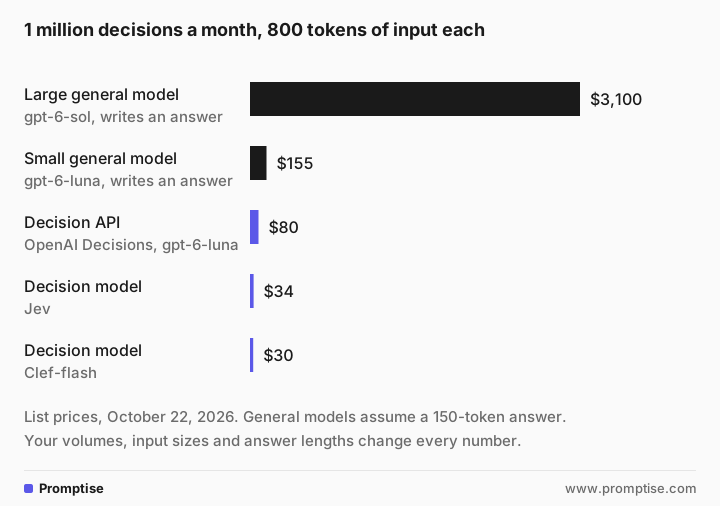
Approach | Monthly cost at list price | Source of the price |
|---|---|---|
Large general model (gpt-6-sol) writes an answer | about $3,100 | OpenAI pricing page |
Small general model (gpt-6-luna) writes an answer | about $155 | OpenAI pricing page |
OpenAI Decisions API (gpt-6-luna) | about $80 | OpenAI Decisions guide |
Jev | about $34 | TypeSafe models page |
Clef-flash | about $30 | Cloudflare Workers AI |
Two lessons come out of this table. First, most of the saving comes from taking routine decisions away from a large general model. If your team already uses a small model, a decision model roughly halves the cost of that step, which matters at scale but won't transform a budget. Second, these are list prices for one decision step. Your real bill depends on how much text each decision reads, how many decisions you make, and what else the system does.
Cost is not the only gain:
Waiting time. A decision model doesn't generate an answer word by word, so it usually responds faster. Vendors publish speed figures from their own tests; measure from your own systems before you promise anything to customers.
Predictable output. The answer is always one of the options you wrote, so downstream software doesn't break on an unexpected sentence.
A dial for risk. Because each answer comes with a probability, your team can set rules like "act automatically above 0.95, send everything else to a person", and adjust that dial as they learn.
[05]
When to use decision models (and when not)
Good fit | Poor fit |
|---|---|
The same question asked thousands of times | One-off or rare decisions |
A short, fixed list of possible answers | Open questions with no fixed answers |
A wrong answer is cheap to catch or undo | A wrong answer is expensive or irreversible |
You can collect past examples with known right answers | Nobody can say what the right answer was |
The output feeds software: a queue, a flag, a score | The output must be read by a customer or explained |
Some decisions should not be automated by any AI model on its own. Decisions about a person's job, pay, credit, health or legal situation need human judgment, and HR or legal must be involved before AI touches them. Microsoft's documentation for its own decision model says the same: use it for decision support with meaningful human review in those cases. Some uses of AI are regulated in some places. Ask your legal and compliance team what applies to you before you roll this out.
[06]
How to run a safe decision-model pilot
Pick one decision. Choose something frequent, low-risk and already done by people or by a slower AI step. Ticket routing and "does this need review?" checks are good first candidates.
Write the question and the answers. Keep the list short and clear, and add "can't tell" where a forced choice would be wrong. Have the people who make this decision today agree on the wording.
Collect past examples with known answers. 200 to 500 is enough for a first test. Use real cases, including the messy ones.
Test two vendors on those examples. Your developers send the same questions to each and compare how often each is right, how sure it is when it is wrong, how fast it responds and what it costs. The guide on calibrating LLM classifiers with a labeled set shows how.
Set the automation line. Decide what share of mistakes you can accept on the automated part, then let the test results set the confidence level above which software acts alone. Everything below it goes to a person.
Run in shadow mode first. For two to four weeks, let the model decide alongside your team without acting, and compare.
Go live on the confident share only. Keep people on the uncertain cases, check a sample of automated decisions every week, and name one owner for the question wording and the threshold.
Your developers can find the technical version of this, including how to plug a decision model into an AI agent's approval step, in decision models for AI agents.
[07]
Pilot readiness checklist
Copy this list into your planning document. Every item should be true before the pilot acts on a single decision:
One decision chosen, with a named owner.
Question and answer options written down and agreed by the people who make the decision today.
200 or more past examples with known right answers.
Two vendors tested on the same examples.
Accepted error rate for automated decisions agreed with the business owner.
Automation threshold set from the test, not by feel.
A person reviews every decision below the threshold.
Shadow-mode period planned, with a comparison report at the end.
Weekly sample check of automated decisions scheduled.
Rule for what happens when the vendor's service is down (for example: everything goes to people).
Legal and compliance asked whether anything applies to this use.
Plan to re-test when the vendor releases a new model version.
[08]
Questions to ask your team
Which of our AI steps make the same decision over and over, and what do they cost today?
Which of those decisions could be written as a short list of answers?
Do we have past examples with known right answers? If not, how long would 200 take to label?
What happens today when the decision is wrong, and who notices?
How would we know if the model's accuracy dropped next month?
Which vendor would we use, and could we switch if prices or quality change?
[09]
Common mistakes
Mistake | Why it fails | Fix |
|---|---|---|
Starting with a high-stakes decision | Errors are costly and trust is lost early | Start with routine, reversible decisions |
Trusting the vendor's benchmark | Vendors test on their own tasks | Test on your own past examples |
Setting the confidence threshold by feel | "90% sure" may not mean 90% right on your data | Set it from a test on labeled examples |
Removing people entirely | The unsure cases still need judgment | Keep people on everything below the threshold |
Counting only the model bill | Labeling, monitoring and review time cost money too | Include them in the business case |
Asking it to explain decisions | Decision models give no reasons | Use a general model where explanations are needed |
Never re-testing | New model versions change behavior | Re-test before every version change |
[10]
FAQ
What is a decision model in AI?
A decision model is an AI model that answers a fixed question by choosing from answers you define in advance, and gives a probability for each answer. It doesn't write text. Teams use decision models for routing, flagging and scoring at high volume, where a general chatbot model would be slower and more expensive.
Are decision models cheaper than ChatGPT-style models?
Per decision, yes, because they charge only for the text they read and write nothing. The size of the saving depends on what you compare with. Against a large general model, list prices can be tens of times lower; against a small general model, roughly half, in the example in this guide.
What is Jev?
Jev is a decision model from the company TypeSafe, launched in early access in September 2026. It answers yes/no, pick-one and rating questions with probabilities, and TypeSafe lists its price at $42 per billion input tokens, with nothing charged for output.
Can decision models replace people in routine decisions?
They can take over the share of routine decisions where they are confident and have been tested on your own examples. People should keep the uncertain cases and check a sample of the automated ones. Decisions about people's jobs, pay, credit, health or legal matters should not be left to AI alone.
How long does a decision-model pilot take?
A focused pilot on one decision usually needs a few weeks: one to two weeks to agree the question and collect examples, a few days to test vendors, and two to four weeks of shadow mode before acting on any decisions.
Do we need developers to use decision models?
Yes. Decision models are offered as services that software calls, not as chat apps. A developer connects them to your ticket system, workflow or AI agent, and someone on the business side owns the question, the answers and the threshold.
[11]
Next steps
Understand where decision models sit next to agents: AI agents explained for business leaders and what is an AI agent.
Pick the right first decision: how to choose AI use cases.
Build the business case: how to measure the ROI of AI.
Keep people in the loop: what is human-in-the-loop AI and AI agent governance in practice.
Share with your developers: decision models for AI agents and Jev vs Clef vs OpenAI Decisions API compared.