Contents · 9 sections↓
Why AI agent projects fail is a question many leadership teams will ask in 2027, because Gartner expects more than 40% of agentic AI projects to be canceled by the end of that year. The good news is that the causes are known and mostly visible early. This guide explains the seven reasons agent projects get canceled, the warning signs at 30, 60 and 90 days, and a one-page project charter that makes each project prove itself before it gets more money.
Why do AI agent projects fail?
Most agent projects are not stopped because the AI is bad. They are stopped because costs grow faster than value, nobody can show the value, or the risks look uncontrolled. Underneath those are fixable causes: a task that never needed an agent, no owner or "before" number, a demo mistaken for a product, costs nobody estimated, controls added too late and a process that was never redesigned.
Key takeaways:
Gartner names three reasons: escalating costs, unclear business value and inadequate risk controls.
Many projects never needed an agent. Fixed, repeatable steps are cheaper with ordinary automation.
No baseline, no proof. Without a measured "before" number, a project can't show value and becomes an easy cut.
Demos hide the hard cases. A pilot that works on chosen examples often fails on real ones.
Decide when to stop before you start. A stop rule written on day one turns a slow failure into a cheap one.
[02]
What the evidence says
In June 2025, Gartner predicted that over 40% of agentic AI projects will be canceled by the end of 2027, "due to escalating costs, unclear business value or inadequate risk controls". It described most projects at the time as early experiments "mostly driven by hype" and often misapplied. That is a forecast, not a count, but more recent data points the same way:
In Gartner's 2027 CIO survey (August 31, 2026), only 13% of respondents reported significant value from AI tools so far. Gartner advised ending "zombie AI" projects and requiring every AI investment to show business value within 90 days.
IDC reported on October 20, 2026 that 80% of organizations have started deploying agentic AI, but 17% use it enterprise-wide.
Forrester's 2027 budget guidance (July 15, 2026) tells leaders to cut AI pilots that lack governance, ownership, success criteria or a path to scale.
Put together: many companies are starting agent projects, few are scaling them, and budget owners are being told to stop the ones that can't prove themselves.
[03]
The seven reasons agent projects get canceled
An AI agent is software that uses an AI model to decide on steps and then carries them out with tools, such as looking up an order or updating a record. That flexibility is what makes agents useful, and it is also what makes them harder to plan, test and pay for than ordinary software.
Reason | Early warning sign | How to prevent it |
|---|---|---|
1. It didn't need an agent | The steps are the same every time | Use ordinary automation; keep agents for judgment |
2. No owner, no baseline | Nobody can say what the process costs today | Named business owner and a measured "before" number |
3. Demo quality, not production quality | Tested only on hand-picked examples | A test set of real cases, built before the agent |
4. Costs nobody modeled | The estimate covers only the AI bill | Count usage at full volume, reviewer time and retries |
5. Controls added too late | Security sees the agent a week before launch | Identity, approvals, limits and logs from day one |
6. Old process, new tool | The agent is bolted onto a process built for people | Redesign the workflow around what the agent does |
7. Vendor overpromise | "Autonomous" claims without a live trial on your data | Trial on your own cases, with your own measures |
1. It didn't need an agent
Gartner put it plainly: "Many use cases positioned as agentic today don't require agentic implementations." If the steps never change, ordinary automation is cheaper, faster and more predictable. Agents earn their cost where the work needs judgment: reading messy requests, choosing between options, handling exceptions.
2. No owner, no baseline
A project with no business owner has nobody to defend it at budget time. A project with no "before" number can't show improvement. Both make it an easy cut, even if it works. For how to set a baseline, see how to measure the ROI of AI.
3. Demo quality is not production quality
Demos use examples someone chose. Real work brings incomplete requests, unusual cases and systems that time out. Build a test set of a few hundred real past cases, with known right answers, before you build the agent. Then the pilot can be measured against it.
4. Costs nobody modeled
Agents are billed by usage, and one task can involve many AI calls and retries. People also review part of the agent's work, and that time often costs more than the AI itself. Projects whose cost per completed task was never estimated get a surprise at scale. AI budget 2027 shows how to estimate it.
5. Controls added too late
If the security team first sees an agent just before launch, it will find an agent running on a shared key, with no approval step and no log. Launch slips, and the project looks risky. Plan the agent's own identity, approvals for high-impact actions, limits and logs from the start. AI agent governance in practice lists them.
6. Old process, new tool
Gartner's advice is that rethinking workflows from the ground up is often the better path than fitting agents into old ones. An agent added to a process designed for people often just moves the work: people still check everything, now with an extra step. Decide which steps the agent does, which a person does and where they hand over.
7. Vendor overpromise
Gartner called the rebranding of chatbots and automation tools as agents "agent washing", and in 2025 estimated that only about 130 of the thousands of agentic AI vendors are real. Ask every vendor for a trial on your own cases, measured by your own numbers, before you sign.
[04]
Decide early, stop cheaply
The cheapest cancellation is the one made in the first weeks. Build two exits into every project: one before any money is spent, and one at each gate.
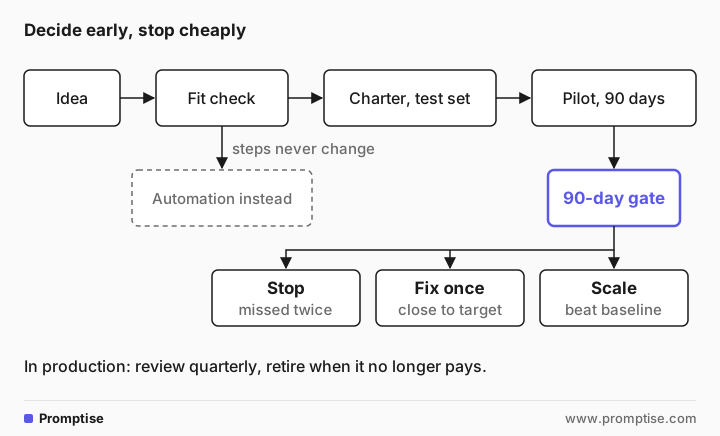
How to set up an agent project so it survives
Run the fit check. Does the work need judgment? Is there enough volume to matter? Is the data the agent needs available? Can a mistake be caught or undone? Is the decision about a person (hiring, pay, credit, health, legal)? If it is, AI should not make it alone, and HR or legal must be involved first.
Write the one-page charter. Owner, baseline, success measure, 90-day target, cost ceiling and stop rule. The template is below.
Build the test set first. A few hundred real past cases with known right answers.
Put controls in from day one. Its own identity, least access, approvals for high-impact actions, spending caps and logs.
Pilot in shadow mode, then limited. First the agent works alongside people without acting, and you compare. Then it acts on a small share of real work.
Hold the 90-day gate. Scale, fix once, or stop, based on the charter's numbers, not on how the demo felt.
Some uses of AI are regulated in some places. Ask your legal and compliance team what applies to you before the pilot touches real work.
[05]
The agent project charter (copy this)
Project:              [name]
Business owner:       [named person who answers for results]
Technical owner:      [named person or team]
Problem:              [one sentence, in business terms]
Why an agent:         [what judgment it needs; why automation is not enough]
Baseline today:       [cost, time or error rate per task, measured how and when]
Success measure:      [one main measure, plus one quality check]
90-day target:        [the number that counts as success]
Test set:             [number of real past cases with known answers]
Cost ceiling:         [maximum cost per completed task, all costs included]
Controls:             own identity / least access / approvals / caps / logs
Pilot plan:           shadow mode [weeks], then limited to [share of work]
Gate date:            [date]       Signers: [owner, finance, security]
Stop rule:            missed gate twice, or [other agreed condition]
If stopped:           revoke access, keep test set and lessons, release budget
The stop rule is the most important line. Write it while everyone is still neutral. Later, people who have worked hard on a project will always find a reason to give it another quarter.
[06]
Warning signs at 30, 60 and 90 days
By day | Healthy | Warning sign |
|---|---|---|
30 | Charter signed; test set built; agent has its own identity | No baseline yet; "we'll measure later" |
60 | Shadow-mode results compared with people's work; cost per task known | Results shown only as examples; scope keeps growing |
90 | Gate review against the charter's numbers | Request for "a few more months" without new evidence |
A pilot that keeps running without passing a gate is what Gartner calls a "zombie" project. It costs money, ties up people and makes the next agent project harder to approve.
[07]
Common mistakes when rescuing a project
Mistake | Why it fails | Fix |
|---|---|---|
Adding features to show more value | More scope means more failure points and cost | Shrink scope to the part that works |
Switching AI models first | The cause is usually data, process or test cases | Check the test set results by type of failure |
Extending the pilot with no new target | It becomes a zombie project | One fix cycle with a dated target, then decide |
Removing human review to cut cost | Errors reach customers and trust is lost | Review only uncertain or high-impact cases |
Blaming the vendor or the model | Hides problems you will repeat | Write a one-page review of what you learned |
Treating cancellation as failure | Teams hide problems instead of stopping early | Reward early, evidence-based stops |
[08]
FAQ
What percentage of AI agent projects fail?
There is no reliable count yet. Gartner predicted in June 2025 that over 40% of agentic AI projects will be canceled by the end of 2027, citing escalating costs, unclear business value and inadequate risk controls. IDC reported in October 2026 that 80% of organizations have started deploying agentic AI, but 17% use it enterprise-wide.
Why do AI agent pilots fail to reach production?
Usually because they can't show value against a measured baseline, their full cost was never estimated, or security finds missing controls late. Many were also built as demos on chosen examples, so they break on real cases. A charter with an owner, baseline, test set and gate date prevents most of this.
How long should an AI agent pilot run?
Long enough to compare the agent with people's work on real cases, usually around 90 days including a few weeks in shadow mode. Gartner advises requiring business value within 90 days. Set the gate date before the pilot starts, and don't extend it without a new, dated target.
What is agent washing?
Agent washing is Gartner's term for vendors rebranding existing chatbots, assistants or automation tools as AI agents without real agent capabilities. In 2025, Gartner estimated that only about 130 of the thousands of agentic AI vendors are real. A trial on your own cases is the best test.
When should you cancel an AI agent project?
Cancel when it misses its agreed gate twice, when the cost per completed task stays above the ceiling in its charter, or when the task turns out not to need an agent. Revoke the agent's access first, keep the test set and lessons, and move the budget to work that is succeeding.
Is it usually the AI model's fault when an agent project fails?
Rarely on its own. Gartner's three reasons, cost, unclear value and weak risk controls, are about planning and management. Model quality matters, but projects with a clear owner, a baseline, real test cases and controls from day one survive model limits far more often than projects without them.
[09]
Next steps
Pick work that suits an agent: how to choose AI use cases.
Understand what agents can and can't do: AI agents explained for business leaders.
Fund projects in stages: AI budget 2027: what to fund first.
Decide whether to build or buy: build vs buy AI agents.
Prove the value: how to measure the ROI of AI.
Before launch, share this with your developers: AI agent production checklist.