Contents · 12 sections↓
- 01What should you fund first in your 2027 AI agent budget?
- 02Why is budgeting for AI agents different?
- 03What the 2027 numbers say
- 04The five budget lines for AI agents
- 05How to release money in stages
- 06Worked example: a first-year agent budget
- 07When not to fund an agent
- 08Budget checklist (copy this)
- 09Questions to ask before you sign the budget
- 10Common mistakes
- 11FAQ
- 12Next steps
Your AI budget for 2027 probably has a new line for AI agents, and the question is what to fund first. Agent costs behave differently from software licenses: they grow with use, much of the cost sits outside the AI bill, and projects that look cheap in a pilot get expensive at scale. This guide gives you a funding order, the five budget lines agents need, a way to release money in stages, a worked example and a checklist to bring to your finance team.
What should you fund first in your 2027 AI agent budget?
Fund the controls every agent needs before you fund more agents: a list of the agents you run, an identity for each, logs, spending caps and approval steps. Then fund one or two agents with a named business owner and a measured "before" number. Fund data work only for the agents that prove value, and scale only the winners. Release money in stages, each tied to a result.
Key takeaways:
Agent funding is growing much faster than IT budgets. Gartner expects average IT budget growth of 3.7% in 2027 and agentic AI funding growth of 31.8%.
Budget for the whole cost, not the model bill. People reviewing agent work, integration and monitoring often cost more than the AI usage itself.
Foundations first. Controls bought once serve every later agent; skipping them is what gets projects stopped.
Release money in stages. Each stage needs a result before the next one is funded.
Plan for success, too. An agent people like gets used more, and its running cost grows with it.
[02]
Why is budgeting for AI agents different?
An AI agent is software that uses an AI model to decide on steps and then carries them out with tools, such as updating a record or sending a reply. (If you need the basics, read AI agents explained for business leaders.) Three things make agents harder to budget than other software.
Costs follow usage. AI services charge by the "token", a small piece of a word; a page of text is roughly 600 to 800 tokens. An agent may call the model ten or more times for one task, re-reading its instructions and earlier steps each time. More use means a bigger bill, every month.
Much of the cost is outside the AI bill. Someone has to connect the agent to your systems, test it, review a share of its work, watch it in production and fix it when it breaks. In Gartner's 2027 CIO survey, 51% of CIOs expect AI to increase total cost of ownership over the technology's life.
Success raises the cost. A useful agent gets more work. Without per-agent spending caps, a popular agent can overshoot its budget before anyone notices.
[03]
What the 2027 numbers say
These are the published figures behind most 2027 planning conversations. Each comes from the research firm's own page; dates matter, because forecasts change.
Finding | Source and date |
|---|---|
IT budgets grow 3.7% on average in 2027; agentic AI funding grows 31.8%, the fastest-growing area | Gartner, CIO planning for 2027, August 31, 2026 |
37% of respondents have deployed AI agents; another 34% plan to within 12 months | Same Gartner article |
Only 13% reported significant value from AI tools so far | Same Gartner article |
Gartner recommends ending "zombie" AI projects and requiring business value within 90 days | Same Gartner article |
More than 80% of leaders expect budget increases; Forrester advises cutting AI pilots that lack governance, ownership, success criteria or a path to scale | Forrester, 2027 Budget Planning Guides, July 15, 2026 |
69% of organizations see a significant gap between AI spending and measurable financial results | IDC blog, October 20, 2026, citing IDC's 2026 AI Economics and Cost of Ownership Survey |
Worldwide IT spending reaches $7.35 trillion in 2027, up 15%, with memory prices that more than doubled in a year | Gartner forecast, October 21, 2026 |
The pattern is clear: money for agents is growing, proof of value is not keeping up, and analysts are advising budget owners to fund in stages and stop what doesn't deliver.
[04]
The five budget lines for AI agents
Give each line its own owner and its own number, so nothing hides inside "AI".
Budget line | What it pays for | Often forgotten |
|---|---|---|
1. Foundations and controls | Agent inventory, an identity for each agent, approval steps, logs, spending caps, monitoring | Usually, until an incident |
2. Building agents | Team time, connecting systems, test sets with known right answers | Test sets and rework |
3. Running costs | AI model usage, hosting, tool and platform fees, a contingency | Retries, loops, growth from success |
4. Data and knowledge | Fixing the specific sources your agents read: policies, product data, process documents | Ongoing upkeep |
5. People and change | Training, redesigning the process around the agent, people reviewing agent work | Reviewer time, every month |
Line 1 is shared. It is bought once and serves every agent that follows, so it shouldn't be charged to the first project and make it look too expensive. Line 4 follows Forrester's 2027 advice to fund targeted data fixes and "governed enterprise knowledge" that agents can use, rather than broad cleanup projects.
[05]
How to release money in stages
Approve the full-year envelope, but release it in tranches. Each tranche needs a result that someone outside the project can check. If a gate is missed twice, stop and move the money.
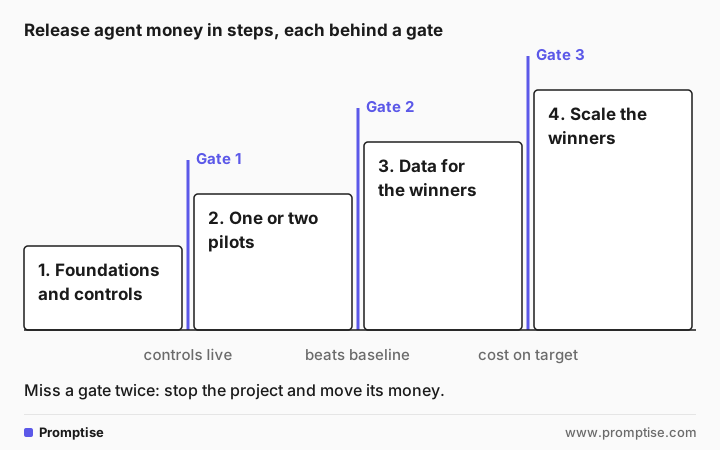
Gate | Evidence required | Who signs |
|---|---|---|
After foundations | Every running agent is listed with an owner; agents have their own identities; logs and spending caps are switched on | CIO or CISO |
After a pilot (about 90 days) | The agent beats the "before" number on the agreed measure; cost per accepted outcome is known | Business owner and finance |
Before scaling | Cost per accepted outcome stayed on target for two months; incidents were handled as planned | Business owner, finance and security |
"Cost per accepted outcome" means total cost divided by the tasks the agent completed that a person or check accepted, such as resolved tickets or correct invoices. It is a better measure than cost per AI call, because a cheap agent that gets half its work wrong is not cheap. For how to measure the "before" number and value, see how to measure the ROI of AI.
[06]
Worked example: a first-year agent budget
Here is how one company planning its first two production agents might split a 2027 envelope. The figures are an illustration of the method, not a benchmark; your numbers will differ.
Line | Amount | Released |
|---|---|---|
Foundations and controls | $180,000 | January |
Building two agents | $360,000 | January, in two halves per agent |
Running costs, including a contingency | $120,000 | Monthly, against caps |
Data and knowledge for the winners | $120,000 | After the pilot gate |
People and change | $120,000 | With each pilot |
Held back to scale winners | $300,000 | Only after the scale gate |
Total | $1,200,000 |
A quarter of the money is held back. If one pilot fails its gate, half of that reserve can go to the agent that passed, or back to the business.
Estimating one agent's running cost
Running costs are where finance teams get surprised. Estimate them bottom-up with your vendor's current price list. An illustrative example, with an assumed price of $1 per million input tokens and $5 per million output tokens:
The agent handles 1,500 requests a working day, about 33,000 a month.
Each request takes about 8 model calls, reading about 32,000 tokens and writing about 2,400 in total.
Model usage: about 1,056 million tokens read ($1,056) and 79 million written ($396), so roughly $1,450 a month.
People review 10% of the work at 2 minutes each: 110 hours a month. At a loaded cost of $60 an hour, that is $6,600 a month.
In this example, review time costs more than four times the AI usage. That is common, and it is why line 5 matters. Cutting review time safely, by reviewing only uncertain or high-impact cases, often saves more money than switching to a cheaper model.
Add a contingency to running costs, because agents retry failed steps and sometimes loop. Ask your developers to put a hard spending cap on each agent, so a fault costs a known amount instead of an open-ended one. They can see how in AI agent cost control.
[07]
When not to fund an agent
Some proposals shouldn't get agent money at all. Gartner's June 2025 forecast that over 40% of agentic AI projects will be canceled by the end of 2027 also noted that many use cases sold as "agentic" don't need agents. Say no, or redirect, when:
The steps never change. Ordinary automation is cheaper and more predictable.
Nobody owns the result. No owner means nobody to sign the gate.
There is no "before" number. Without one, you can't show value at 90 days.
The decision is about a person. Decisions on hiring, pay, credit, health or legal matters should not be left to an agent alone; HR or legal must be involved before any agent supports them.
Some uses of AI are regulated in some places. Ask your legal and compliance team what applies to you before you commit the budget.
[08]
Budget checklist (copy this)
[ ] Inventory of every AI agent we already run, with owners
[ ] Foundations line funded separately (identity, approvals, logs, caps, monitoring)
[ ] Each funded agent has a named business owner
[ ] Each funded agent has a measured "before" number
[ ] Success measure and 90-day target written down per agent
[ ] Running cost estimated bottom-up from current vendor prices
[ ] Reviewer time included in the cost of each agent
[ ] Contingency on running costs, and a hard spending cap per agent
[ ] Money released in stages, with gate evidence and signers agreed
[ ] Rule for stopping: two missed gates ends the project
[ ] Reserve held back for scaling the agents that pass
[ ] Finance agrees how agent costs are charged to business units
[ ] Legal and compliance asked whether anything applies to our uses[09]
Questions to ask before you sign the budget
Which agents are we already paying for, and who owns each one?
For each new agent, what does the process cost today, and what will we measure at 90 days?
What will one month of this agent cost at full volume, including the people who check its work?
What stops the bill if the agent misbehaves at 3 a.m.?
Which business unit pays for usage, and does it own the result?
What would we stop doing if a pilot fails its gate?
Gartner's survey suggests the last two questions matter: 73% of enterprises have no plans to set ownership rules for technology costs and solutions, and Gartner advises aligning ownership with cost allocation.
[10]
Common mistakes
Mistake | Why it fails | Fix |
|---|---|---|
Budgeting only the AI bill | Review, integration and monitoring cost more | Use the five lines and count reviewer time |
Charging foundations to the first project | The first agent looks too expensive and gets cut | Fund foundations as a shared line |
Funding many pilots at once | None gets enough attention to prove value | Fund one or two, with owners |
Releasing the full year up front | Weak projects keep spending | Release in stages against evidence |
Using last year's prices | Model prices and hardware costs change quickly | Re-estimate from current vendor prices each quarter |
No spending cap per agent | One fault becomes a large bill | Hard caps and alerts per agent |
Measuring cost per AI call | Cheap calls with wrong answers aren't cheap | Measure cost per accepted outcome |
[11]
FAQ
How much should we budget for AI agents in 2027?
There is no reliable universal number. Build the budget bottom-up: foundations once, then each agent's build cost, running cost at full volume and reviewer time. For context, Gartner reports that IT budgets will grow 3.7% on average in 2027 while agentic AI funding grows 31.8%, so many companies are moving money from elsewhere.
What share of the AI budget should go to governance and security?
No published benchmark is solid enough to copy. A practical rule is to fund the foundations, meaning inventory, agent identities, approvals, logs and spending caps, before you fund a second agent, and to keep them as a shared line rather than charging them to one project.
What is stage-gated funding for AI?
Stage-gated funding approves a full-year budget but releases it in tranches. Each tranche is released only after the project shows agreed evidence, such as beating a measured baseline within about 90 days. Projects that miss a gate twice stop, and their money moves to work that is succeeding.
Why do AI agent costs grow after launch?
Agents are billed by usage, and a useful agent gets used more. Each task can involve many AI calls, retries and tool calls, and people still review part of the work. Without per-agent spending caps and monthly cost reviews, success alone can push an agent over budget.
What should we cut from the AI budget in 2027?
Forrester's 2027 guidance is to cut AI pilots that lack governance, ownership, success criteria or a path to scale, and Gartner recommends ending "zombie" AI projects that consume money without delivering value. Start with pilots that have no owner or no measured baseline.
Who should own the AI agent budget, IT or the business?
Usually both, split by line. IT or a central AI team owns the shared foundations; each business unit owns the build, running and people costs of its own agents, along with the results. Gartner advises aligning technology ownership with cost allocation, so whoever pays for an agent also answers for what it delivers.
[12]
Next steps
Find what you already run: AI agent inventory.
Pick the agents worth funding: how to choose AI use cases.
Decide whether to build or buy: build vs buy AI agents.
Measure the return: how to measure the ROI of AI.
Set up the controls your foundations line pays for: AI agent governance in practice.
Avoid the common failure patterns: why AI agent projects get canceled.