Contents · 11 sections↓
- 01Should customers' AI agents use your website?
- 02What kinds of AI traffic reach your website?
- 03How can a website tell a real agent from a bad bot?
- 04The agent protocols in plain words
- 05Decide action by action
- 06Give agents a proper door
- 07A step-by-step plan
- 08Questions to ask your team
- 09Common mistakes
- 10FAQ
- 11Next steps
Should AI agents use your website? Customers now send AI agents to compare prices, book appointments, check orders and even buy things for them. Some companies block every bot; others welcome agents without knowing who they are. This guide explains, in plain words, what kinds of agents reach your site, how websites can tell them apart, what the new agent protocols do, and how to decide action by action what agents may do.
Should customers' AI agents use your website?
In most cases, yes, on your terms. Let identified agents read public information and do low-risk tasks, give them a proper door such as an API for the actions you want to support, and require the customer's explicit permission for anything that touches an account or money. Block or slow down traffic that won't identify itself. Blocking every agent also turns away the customers who sent them.
Key takeaways:
Not all AI traffic is the same. Search crawlers, training crawlers and agents acting for a customer need different answers.
Identity comes first. New standards let agents sign their requests, so your site can tell a known agent from an anonymous bot.
Decide per action, not per bot. Reading a price list and placing an order carry very different risks.
A good door beats scraping. An API or MCP server is cheaper for you and more reliable for agents than having them click through pages.
The protocols are young. Several are drafts or betas, so plan for change.
[02]
What kinds of AI traffic reach your website?
Much of your traffic is already not human. Cloudflare, which carries a large share of web traffic, reported in July 2026 that "more than 50% of traffic on the Internet is now non-human."
Cloudflare's AI traffic categories (July 1, 2026) are a useful way to sort it:
Kind | What it does | Example question for you |
|---|---|---|
Search | Collects your pages so an AI can answer questions about them later | Do we want to appear in AI answers? |
Training | Takes your content to train or fine-tune a model | Do we allow our content to train models? |
Agent | Acts in real time for a person, to get something done now | What may an agent do for our customer? |
This guide is about the third kind: an agent working for one of your customers or prospects. It might be a browser agent that clicks through your pages, a chat assistant that fetches a page to answer a question, or a personal agent that books, orders or changes things.
Note that Cloudflare also changed a default: from September 15, 2026, new domains on its network have training and agent traffic blocked by default on pages that show ads. If your site sits behind Cloudflare or a similar service, check what your current settings allow before you decide anything.
[03]
How can a website tell a real agent from a bad bot?
Until recently it couldn't, reliably. Bots can claim any name, and blocking by network address fails against traffic routed through home internet connections. Three developments change that:
Signed requests. An agent can add a cryptographic signature to each request, which proves which company operates it. The approach is being standardized at the IETF, the body that writes internet standards, in the Web Bot Auth working group as "HTTP Message Signatures for automated traffic", a working-group draft dated September 1, 2026. Cloudflare lists agents that sign this way as signed agents.
The customer's permission. The Personal Agent Protocol, announced by Sierra and Meta on October 6, 2026, lets a customer decide what access their agent gets, including read-only or write, and lets the company set what agents may do. It is built on OAuth, the same standard behind "Sign in with..." buttons. It is a draft heading toward version 1.0.
Payment-specific checks. Card networks and payment companies have their own protocols so merchants can trust an agent that pays, such as Visa's Trusted Agent Protocol.
Put simply: identity tells you who runs the agent, permission tells you what the customer allowed, and payment protocols tell you the purchase is authorized.
[04]
The agent protocols in plain words
Protocol | Who is behind it | What it is for | Status and date |
|---|---|---|---|
Sierra and Meta, with partners including Shopify, Stripe and Walmart | How a customer's agent signs in to a business and what it may do | Draft; announced 2026-10-06 | |
IETF working group | Agents and bots sign their requests so sites can verify them | Draft; 2026-09-01 | |
Visa, with Cloudflare | Lets merchants recognize legitimate shopping agents | Announced 2025-10-14 | |
Google, with partners | Signed proof of what the customer asked the agent to buy | Announced 2025-09-16 | |
OpenAI and Stripe | Checkout flows between buyers, AI agents and businesses | Launched 2025-09-29 | |
Proposal by Jeremy Howard | A plain-text summary of your site for AI models | Proposal; 2024 |
You don't need all of these. Your choice depends on what you sell and which payment providers and platforms you already use; ask them which protocols they support.
[05]
Decide action by action
The useful question is not "agents: yes or no?" but "which actions, by which agents, with what permission?"
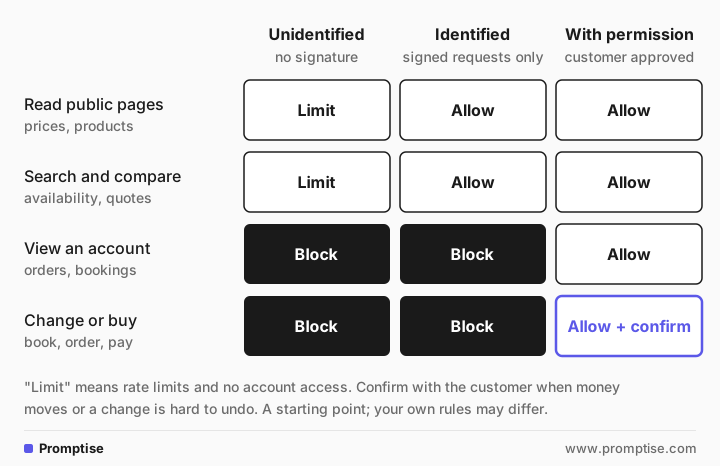
Action | Risk to you and the customer | A sensible default |
|---|---|---|
Read public pages and prices | Low; mainly load on your servers | Allow identified agents; rate-limit the rest |
Search, compare, check availability | Low to medium; heavy use can be costly | Allow, with limits; offer an API for volume |
Sign in and view an account | Medium; personal data | Only with the customer's explicit permission |
Change something (booking, address) | Medium to high; mistakes reach real people | Customer permission, plus confirmation for changes that are hard to undo |
Buy or pay | High; money moves | Use a payment protocol your provider supports, and confirm with the customer |
Whether your terms of use allow agents, and what they should say, is a question for your legal team.
[06]
Give agents a proper door
An agent that clicks through your website is slow, breaks when you change a page, and costs you server capacity. If you want agents to do something, a direct door is better for both sides. There are three:
The website, for reading. Clear pages, structured data and an llms.txt summary help agents read accurately.
An API described with an OpenAPI file, a standard format that tells software what each operation does. Developers and their agents can call it directly.
An MCP server, a small layer on top of your API that AI assistants such as Claude and ChatGPT can connect to. The Personal Agent Protocol names APIs, via MCP and OpenAPI, as one of the ways agents can reach a company.
Your product and engineering teams can find the technical side in should your SaaS ship an MCP server, an OpenAPI spec, or both?. Tools exist to generate an MCP server from an existing API; Promptise Foundry's MCPcast is one, and the guide on turning a REST API into an MCP server covers the approach.
[07]
A step-by-step plan
Measure. Ask your web team how much traffic is automated, which agents identify themselves, and which pages they hit. Your CDN or bot-management provider usually has this report.
Check your defaults. Find out what your CDN and security settings already block or allow for AI traffic.
List the actions. Write down what customers do on your site: browse, search, book, buy, change, cancel.
Set a rule for each action. Use the table above as a starting point. Involve customer service, security and the owners of checkout and accounts.
Pick a door for the actions you want agents to do. Website for reading; API or MCP for anything frequent or account-related.
Require permission for accounts and money. Prefer standard sign-in (OAuth) and your payment provider's agent support over building your own.
Set limits and logging. Rate limits per agent, and records of which agent did what for which customer.
Publish your stance. A short developer page saying how agents should identify themselves and what they may do.
Review quarterly. The protocols and the agents change fast.
[08]
Questions to ask your team
How much of our traffic is automated today, and how much of it identifies itself?
What does our CDN or bot protection block by default for AI agents?
Which customer tasks would we like agents to complete, and which would we not?
Do we have an API that covers those tasks? Is it documented with OpenAPI?
How would we know which agent acted for which customer, if something went wrong?
Which agent protocols do our payment provider and e-commerce platform support?
Who owns this decision, and who reviews it each quarter?
[09]
Common mistakes
Mistake | Why it fails | Fix |
|---|---|---|
Blocking all AI traffic | Turns away customers and search visibility along with bad bots | Sort by kind and decide per action |
Allowing everything | Load, scraping and account abuse with no way to tell who did it | Require identification; limit the rest |
Trusting the name a bot gives | Names are easy to fake | Prefer signed requests and verified lists |
Letting agents scrape account pages | Breaks often and puts personal data at risk | Offer an API with customer permission |
Building a custom agent protocol | Agents won't adopt one-off rules | Use the standards your providers support |
Deciding once | Protocols and defaults change monthly | Review quarterly |
[10]
FAQ
What is agentic commerce?
Agentic commerce is shopping where an AI agent does some of the work for a person: searching, comparing, filling in forms and sometimes paying. Businesses take part by making their products readable and their actions available to agents, with the customer's permission for anything that involves an account or money.
What is the Personal Agent Protocol?
It is an open standard announced by Sierra and Meta on October 6, 2026, with partners including Shopify, Stripe and Walmart. It defines how a customer's personal agent identifies itself to a business and signs in with the customer's permission, built on OAuth. As of October 2026 it is a draft working toward version 1.0.
Should I block AI agents on my website?
Block or limit agents that won't identify themselves, especially on account and checkout pages. Allow identified agents to read public information, and let them act on accounts only with the customer's permission. A blanket block also turns away customers who use agents.
How do I know if AI agents are visiting my site?
Your CDN, bot-management or analytics provider can usually separate automated traffic and show which agents identify themselves. Agents that sign their requests with Web Bot Auth can be verified; others can only be guessed from their behavior.
Do I need an MCP server for AI agents?
Not to be readable. For agents that should take actions, such as booking or checking orders, a documented API comes first, and an MCP server on top of it makes those actions easy for AI assistants to use.
[11]
Next steps
Understand what agents are: AI agents explained for business leaders and what is an AI agent.
Share the technical side with your product team: MCP server, OpenAPI spec, or both and what is MCP.
Secure the door: MCP security best practices and AI agent identity and authentication.
Decide who owns it: who owns an AI agent?.