Contents · 8 sections↓
Many companies have a spending commitment with AWS, Microsoft Azure or Google Cloud, and a separate budget line for AI models. Increasingly, the two can meet: all three clouds now sell models from OpenAI, Anthropic and others on the cloud bill. This short guide explains, from each cloud's own documentation, how buying AI models through your cloud works, what to check before you do it, and how it differs from buying directly from the model vendor.
Can you buy AI models through your cloud commitment?
Often, yes. AWS, Azure and Google Cloud each sell third-party AI models on your cloud invoice, and each documents cases where that spend counts toward an existing cloud commitment. Whether a specific model counts depends on how the cloud sells it and on the terms of your own agreement, so confirm each offer with your cloud account team before you plan around it.
Key takeaways:
One bill, one commitment. Buying through the cloud puts model spend on the cloud invoice, where eligible purchases count toward what you already committed to spend.
"Eligible" is the key word. Each cloud decides eligibility per product, and your agreement may set limits.
The cloud version may differ. Features, release timing, regions and quotas can differ from the vendor's own API.
News this week. On October 21, 2026, Google Cloud began offering OpenAI models in private preview, with usage that "draws down existing cloud commitments."
Keep switching cheap. If the model choice is a setting in your software, moving between direct and cloud routes is easy.
[02]
How cloud commitments and marketplaces work
A cloud commitment is an agreement to spend a set amount with a cloud provider over a period, usually in return for better prices. Microsoft describes its version, the Microsoft Azure Consumption Commitment (MACC), as an agreement in which "your organization commits to a specified level of Azure spending over a defined period."
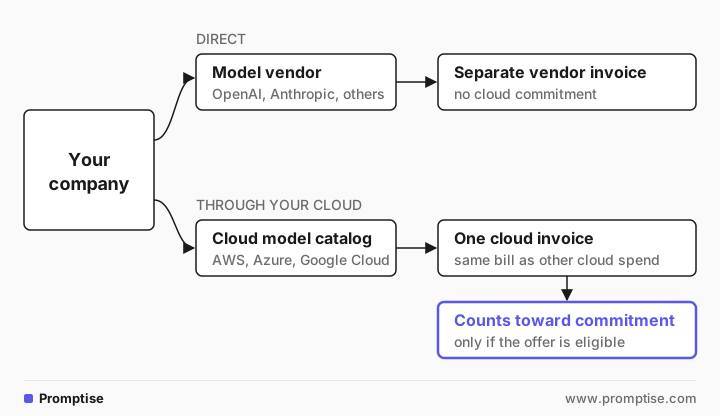
A cloud marketplace is the cloud's store for products from other companies. Purchases appear on your cloud bill instead of a separate vendor invoice. When a marketplace purchase is eligible, it draws down the commitment: it counts as spending you promised to make.
AI models reach you through the cloud in two ways:
Sold by the cloud itself, such as OpenAI models in Azure, which Microsoft lists among the models "sold by Azure" and bills "through your Azure subscription" (Microsoft Learn).
Sold by the model vendor through the cloud's marketplace, such as Claude in Microsoft Foundry or OpenAI models on Google Cloud, billed by the cloud on the vendor's behalf.
[03]
What each cloud says
Cloud | How third-party models are sold | What the cloud's own pages say about commitments |
|---|---|---|
Google Cloud | Model Garden, transacted through Google Cloud Marketplace | OpenAI models (GPT-6 Astra, GPT-6.1 Sol, GPT-6 Luna, private preview since October 21, 2026) appear "on a single Google Cloud invoice" and draw down "existing cloud commitments" (Google Cloud blog). Third-party model spend draws down the enterprise commitment "subject to... contract caps defined in your enterprise agreement" (Flexible Savings Plans doc). |
AWS | Amazon Bedrock; some models are billed through AWS Marketplace as third-party content | AWS says customers "will see an AWS Marketplace bill for certain Bedrock serverless models" (Bedrock FAQ). For OpenAI models and Codex on Bedrock, usage "can be applied toward existing AWS cloud commitments" (AWS, April 28, 2026). |
Azure | Azure OpenAI sold directly by Azure; other vendors' models through Azure Marketplace | Claude usage in Microsoft Foundry is billed on a "MACC-eligible" meter that "decrements your Microsoft Azure Consumption Commitment" (Microsoft Learn). Marketplace offers that count carry an "Azure benefit eligible" badge, and credit-card purchases "do not contribute" (Microsoft Learn). |
For Azure's own services, Microsoft says you can check in the Azure portal which services and Marketplace offers are eligible for MACC decrement (Microsoft Learn).
[04]
Direct from the vendor vs through your cloud
Factor | Direct from the vendor | Through your cloud |
|---|---|---|
Invoice | Separate vendor contract and bill | On the cloud bill you already have |
Commitment | Does not count toward a cloud commitment | Counts when the offer is eligible under your agreement |
Features and timing | New features usually arrive first | May lag or be missing; check the vendor's docs |
Data path | Data goes to the model vendor | Often stays within the cloud's boundary; check each offer |
Quotas and capacity | Set by the vendor | Set by the cloud, with its own request process |
Support | From the vendor | Usually from the cloud provider |
Two examples from Anthropic's own documentation show why "check the docs" matters. Its page on Claude in Amazon Bedrock lists features not supported there, including the Files API, server-side tools such as code execution and web search, and Message Batches. The same page says regional endpoints, which keep processing in one region, carry a 10 percent premium over global endpoints. On the data side, AWS states that on Bedrock "Users' inputs and model outputs are not shared with any model providers."
[05]
Questions to ask before you move model spend to your cloud
Ask your cloud account team:
Is this specific model offer eligible to draw down our commitment?
Is there a cap on how much third-party spend can count?
Is it generally available, or in preview with limited access?
Do our existing discounts with the model vendor carry over?
Ask your engineering team:
Which vendor features do we use today, and are they all available on the cloud version?
Which regions do we need, and does the cloud offer them for this model?
What quotas do we need, and how long do increases take?
Can we switch back if a feature we need arrives late on the cloud?
Your commitment's terms are in your own agreement; review them with your procurement and legal teams before you rely on any of the above.
It also helps if switching is cheap on the software side. Agent frameworks that treat the provider as configuration make this a setting rather than a project. Promptise Foundry, for example, runs OpenAI, Azure OpenAI, Anthropic, Amazon Bedrock and Google Vertex AI models with the same agent code; see Azure OpenAI agents with MCP and Gemini agents with MCP.
[06]
Common mistakes
Mistake | Why it fails | Fix |
|---|---|---|
Assuming every model on the cloud counts | Eligibility is set per offer and by your agreement | Confirm each offer with the account team |
Buying a marketplace offer by credit card | Microsoft says these purchases don't count toward MACC | Buy through the cloud portal on your agreement's subscription |
Moving before checking features | Some vendor features are missing on cloud versions | List the features you use and compare first |
Counting on a preview | Preview access can be limited and change | Plan production on generally available offers |
Hard-wiring one route in code | Switching later becomes a project | Keep the provider in configuration |
[07]
FAQ
Can I use my Google Cloud commitment for OpenAI models?
Google Cloud announced on October 21, 2026 that OpenAI's GPT-6 Astra, GPT-6.1 Sol and GPT-6 Luna are rolling out in private preview, transacted through Google Cloud Marketplace, and that usage draws down existing cloud commitments. Access is limited to select enterprise customers during the preview, and your agreement may set caps.
Does Claude in Microsoft Foundry count toward MACC?
Microsoft's documentation says Claude usage in Foundry is billed on a MACC-eligible meter on your Azure invoice and decrements your Microsoft Azure Consumption Commitment, the same way other Azure Marketplace consumption does.
Is Claude on Amazon Bedrock the same as Anthropic's own API?
The models are the same, but Anthropic's documentation lists features not available on Bedrock, such as the Files API, code execution, web search and Message Batches. Check the list against what your applications use.
Is buying AI models through the cloud more expensive?
Not necessarily. Compare each vendor's price list with the cloud's, and look for extras such as regional processing premiums. The bigger difference is often whether the spend counts toward a commitment you have already made.
[08]
Next steps
Choose the model before the route: best LLM for AI agents and open-weight vs API models.
Decide what to build and what to buy: build vs buy AI agents.
Use cloud-hosted models in an agent: Azure OpenAI agents with MCP, Claude agents with MCP and Gemini agents with MCP.
Check any vendor that holds your keys: AI vendor security questionnaire.